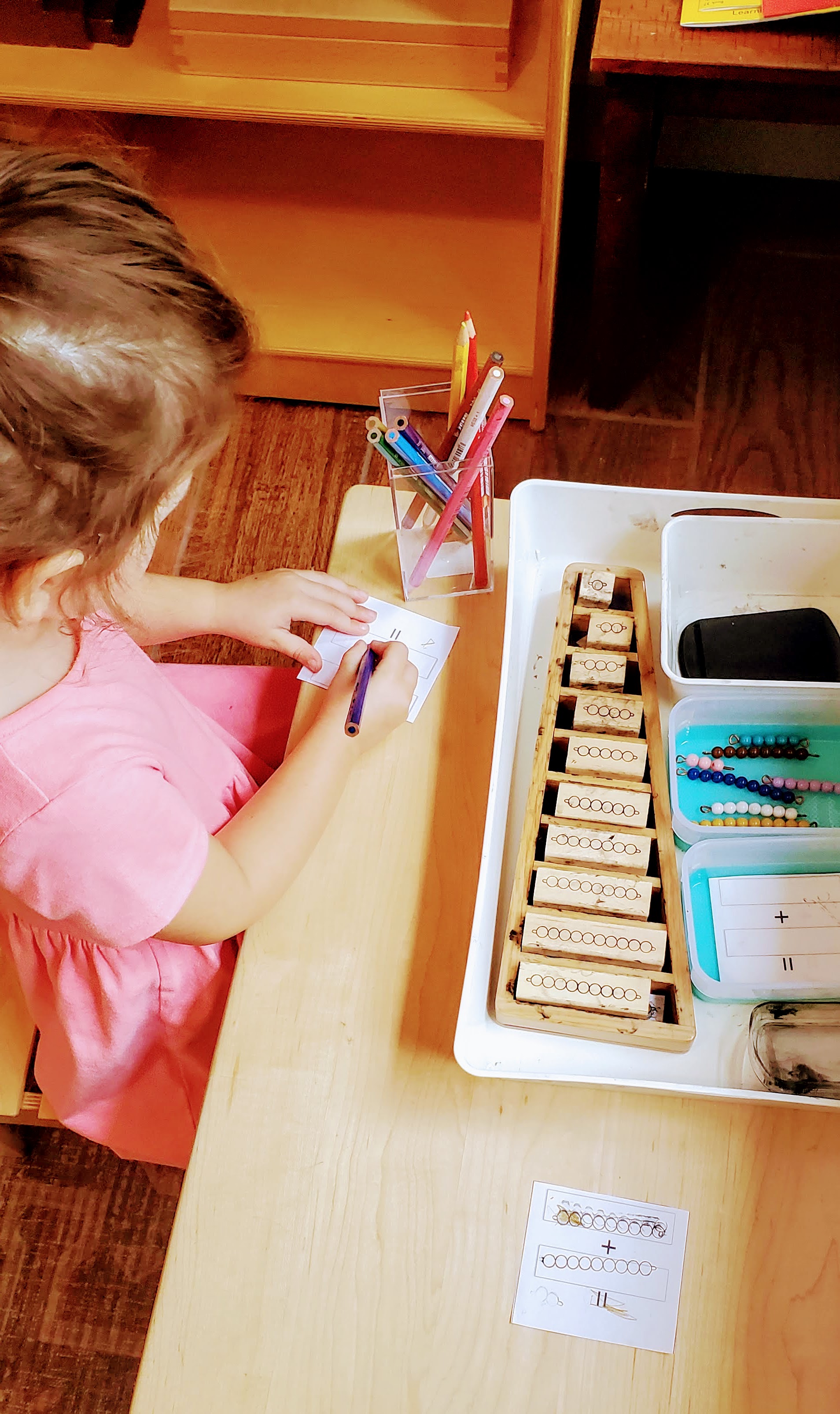

Maria Montessori’s greatest contribution to science and education is her observation of sensitive periods in human beings. She noted the intellectual and spiritual drive toward activities that are necessary to survive in the environment. Sensitive periods are transitory impulses driving human beings to learn specific parts of their environment that last for a brief period of time.
Hugo de Vries (1848-1935), a Dutch biologist, first discovered sensitive periods while observing the metamorphosis of a butterfly. Montessori adapted de Vries idea of sensitive periods to describe the psychic pattern of human beings. Montessori wrote, “Growth and development are therefore guided by: the absorbent mind, the nebulae and the sensitive periods, with their respective mechanisms. It is these that are hereditary and characteristic of the human species. But the promise they hold can only be fulfilled through the experience of free activity conducted on the environment.”[i]
Our law of development reveals a predetermined pattern unlike other species. Animals are born with instincts of its own kind that reach maturity during the gestation period. Human beings are born inert and helpless. The human brain has an infinite amount of potential that requires us to slowly develop our mental powers. Natures deliberate design of brain maturation, psychological order, and body movement work autonomously yet in rhythm to what is needed at that moment in time to survive. In collaboration with the environment a brilliant human being emerges.
Montessori states, “…the newly-born child of man is so evidently and greatly inferior to that of the mammals, he must have a special function which the others do not share…He is therefore, different from animals precisely with regard to heredity. He evidently does not inherit characteristics features, but only the potentiality to form them. It is, therefore, after birth that the characteristics, proper to the particular kind to which the child belongs, are built up.” [ii]
Sensitive periods are broken down into four planes of development. Montessori established four planes of development to describe the physical, emotional, intellectual, and social characteristics of human beings. It is a guide to our psychological order.
- First Plane (7 months gestation-6 years old)
- Second Plane (6-12 years old)
- Third Plane (12-18 years old)
- Fourth Plane (18-24 years old)
SENSITIVE PERIODS: First Plane of Development
Language (7 months gestation to 5 years old)
Seven months gestation, a human being exhibits interest in sounds. Language development is long because of the importance and sequence. The child first absorbs intonations, accent, and vocabulary of language/s in the environment. Annotations are the inflection or strength of pitch. The child adopts its group’s mother tongue.
Order (8 weeks to 2 years old)
Eight weeks to two years old, the sense of order surfaces in a human being. Sometimes this can last until the age of six. The sense of order is often missed. This is a foundation of many things, especially, language and math. This is an internal process and the external environment can aid this sensitive period. This governs the Montessori classroom. The child’s emotional connection to order is visible. If there is a change in their sense of order, the child will be confused and possibly cry.
Control of Movements (Birth to 4 years old)
The child will perfect and control his movements. Noise will measure the control of their movements and self-correct. There is a heightened sense of sequence through habitual movements. The conscious absorbent mind is revealed.
Sensorial Exploration (Birth to six years old)
Manifests in three ways:
- Birth to three years old: general exploration through mouthing, manipulation, texture, size, sound, and color.
- Three years old: earlier sensations are highlighted – color, pitch to sounds, timbre (quality of sound like a tuba vs. flute).
- Four to six years old: sensorial impressions refined.
Sensorial materials engage the sensitive periods. The materials isolate the sensorial impressions and help children interpret their world in a coherent and differentiated manner.
Weaning (5 months +)
Five months old, a baby’s taste expands and they begin mouthing. The baby begins a transition of nourishment. Moving from breastfeeding or bottle to sips from a spoon then on to a cup. The young human being is ready to experiment various foods and their textures. If weaning is started later, the transition is difficult for the baby and mother.
Interest in Tiny Things (2 ½ years old)
A child will be drawn to insects for example.
Tactile Exploration (2 ½ years to 3 ½ years old)
The kinesthetic experience is heightened.
Manners and Courtesy (2 ½ years to 6 years)
First the skills are absorbed through everyday life then later preschoolers act out in exercises. For example preparing a dish, serving the dish, and offering napkins to peers.
Writing (3 ½ years to 4 ½ years old)
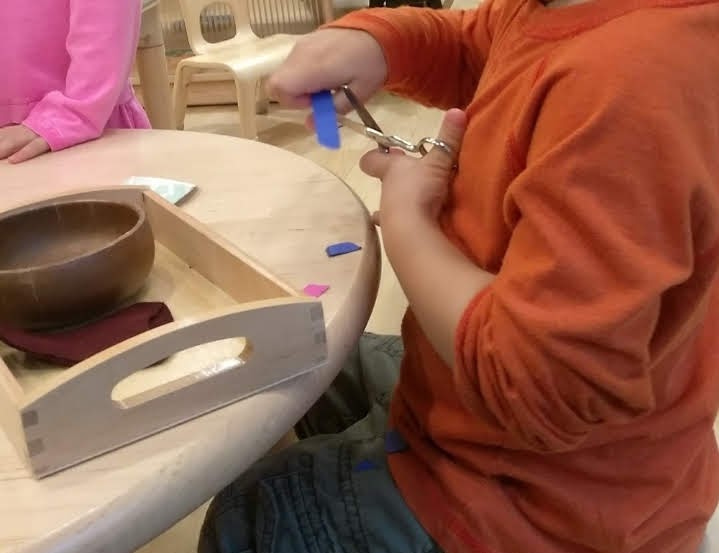
The Montessori environment provides mental and manual materials. For example, to satisfy the manual work, children cutout letters and for mental work they feel sandpaper letters. Writing is fascinating because the child will write a list of words, but cannot read them back.
Mathematics (4 ½ years old)
The child counts by ones and begins to have a concrete and linear understanding. At the toddler age children are interested in numbers because it is building their vocabulary skills.
Reading (4 ½ years – 5 ½ years old)
Emerges through writing. Children begin to decode the meaning of the words and phonetics is a tool for the child and adult.
During the sensitive period acts of will by the child construct the activities in the classroom.
[i] Maria Montessori, Absorbent Mind, (Henry Holt and Company, 1995), p. 96.
[ii] Maria Montessori, The Formation of Man, (Clio Press, 1955), p. 56-57




 The Montessori School of Essex